




Chevy Safety Assist Explained: The Standard Safety Features on Every 2026 Chevy
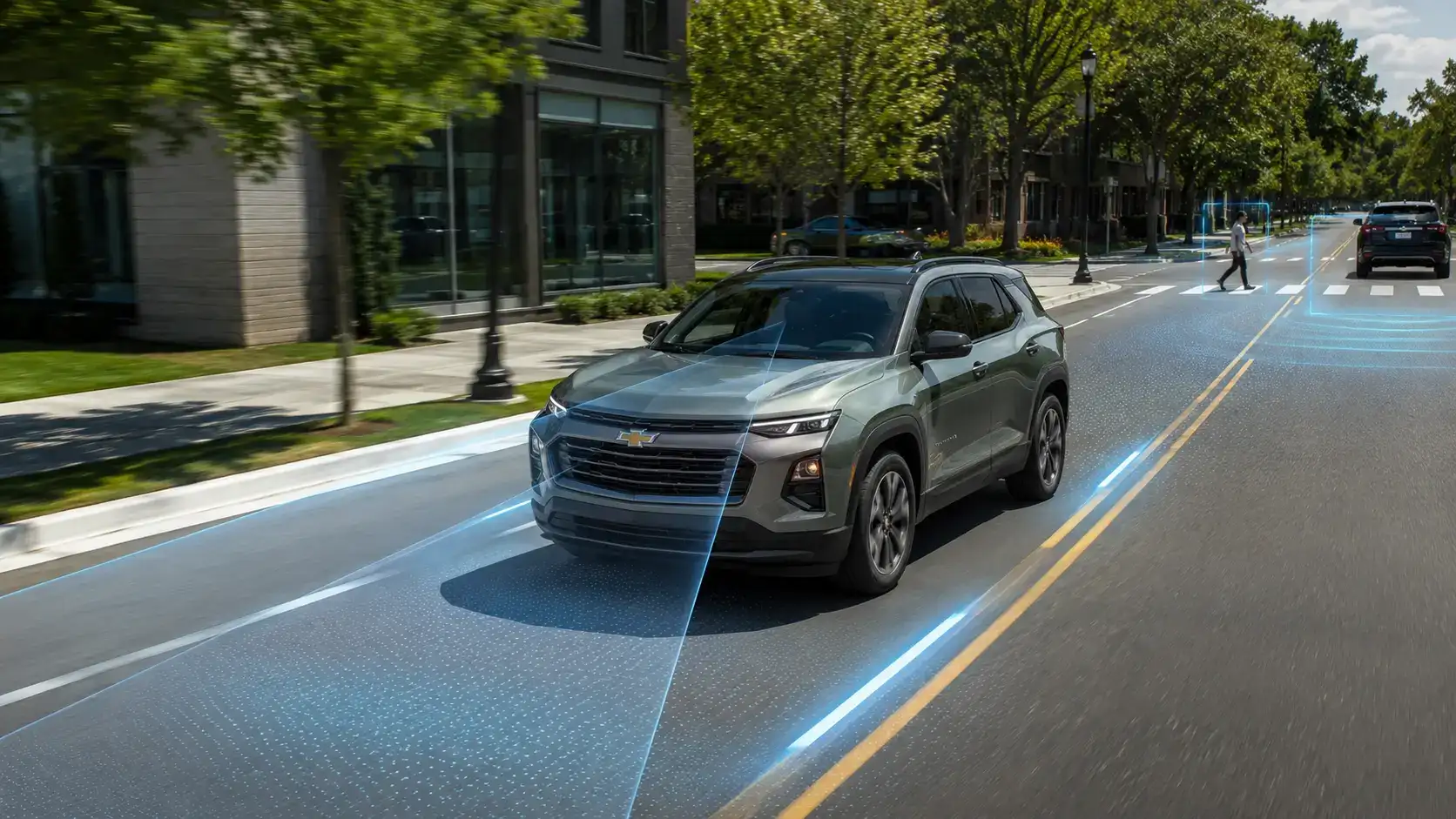
Standard safety technology on a new vehicle is one of the most important purchase considerations, and one of the most commonly misunderstood. Many buyers assume that the safety features they see advertised on a premium trim are available throughout the lineup. Others assume their base-level vehicle includes only the legal minimums. For 2026 Chevrolet vehicles, neither assumption is correct. Chevy Safety Assist is a comprehensive suite of six active driver assistance technologies that Chevrolet includes as standard equipment on every 2026 Chevy vehicle across the full lineup, from the entry Trax to the High Country Silverado, with no package required and no trim level restricted.
At Starling Chevrolet in St. Cloud, we field safety technology questions regularly from buyers who are comparing Chevrolet against competitors with restricted safety standard content or who want to understand what their new Chevy will do in specific situations. This guide covers exactly what Chevy Safety Assist includes, what each system does in practical terms, how it differs from Super Cruise, and why it matters specifically for Central Florida driving conditions.
What Is Chevy Safety Assist?
Chevy Safety Assist is the umbrella term for Chevrolet’s standard active driver assistance package, the suite of technologies that are included on every new 2026 Chevy vehicle as factory-standard equipment without any additional cost, package selection, or trim level requirement. It is not a marketing description of passive safety features like airbags and seat belts that have been required by law for decades. It is an active technology suite that monitors the vehicle’s environment, alerts the driver to specific hazard conditions, and in several cases intervenes autonomously to prevent or mitigate collisions.
The distinction between active and passive safety is important for understanding what Chevy Safety Assist actually does. Passive safety, airbags, crumple zones, seat belt pre-tensioners, protects occupants during a crash. Active safety, which is what Chevy Safety Assist provides, works to prevent the crash from occurring in the first place or to reduce its severity before impact. The six systems in Chevy Safety Assist collectively address the most common crash scenarios in American driving: rear-end collisions, lane departure crashes, pedestrian impacts, and following-distance-related collisions.
The 6 Safety Features Included Standard
Chevy Safety Assist comprises six distinct driver assistance systems. Each addresses a specific crash scenario and operates through a different sensing and intervention mechanism. Together they form a layered active safety approach that covers the vehicle’s forward, lateral, and pedestrian hazard scenarios.
Automatic Emergency Braking and Forward Collision Alert
Forward Collision Alert (FCA) is the first layer: the system monitors the gap between the Chevy and the vehicle ahead, calculates closing speed, and generates an audible and visual alert when the gap has closed to a point where the driver should brake to avoid a collision. FCA is the warning system, it alerts the driver but does not intervene. Automatic Emergency Braking (AEB) is the intervention layer that activates when FCA’s alert is not acted upon and the system determines that a collision is imminent. When AEB activates, the braking system applies automatically at a force and timing calculated to reduce impact speed or avoid the collision entirely.
AEB operates at the speeds where rear-end collisions most commonly occur, from low parking lot speeds through highway traffic speeds, and its effectiveness is well-documented: the IIHS has found that low-speed AEB reduces rear-end crash rates by approximately 50 percent in vehicles equipped with the system. On Central Florida’s I-4 through Kissimmee and the US-192 stop-and-go through St. Cloud, where sudden deceleration from variable traffic speeds is a regular occurrence, AEB and FCA address the most common crash type in the market.
Lane Keep Assist with Lane Departure Warning
Lane Departure Warning (LDW) monitors the vehicle’s position within its lane using forward-facing cameras that track painted lane markings. When the vehicle begins to drift toward or across a lane marking without a turn signal activated, the action characteristic of distracted or fatigued lane departure, LDW generates a warning alert to the driver. Like FCA, LDW is an alert system rather than an intervention system.
Lane Keep Assist (LKA) is the intervention companion: when LDW has generated an alert and the driver has not corrected course, LKA applies gentle steering inputs to guide the vehicle back toward the center of the lane. LKA’s steering inputs are assistive rather than forceful, the system is designed to nudge the vehicle back toward center while maintaining the driver’s ability to override with steering input at any time. For nighttime driving on I-4 between Orlando and Kissimmee, or on the two-lane sections of US-192 east of St. Cloud where lane markings can be faded, LDW and LKA provide the distraction backstop that reduces lane departure risk during extended driving.
Front Pedestrian Braking, IntelliBeam, and Following Distance Indicator
Front Pedestrian Braking is the extension of AEB’s collision avoidance capability to the pedestrian detection scenario, specifically the scenario where a pedestrian enters the vehicle’s path at low speed, in parking lots, at crosswalks, or in the school zones that define daily driving in St. Cloud’s residential and commercial areas. The forward-facing camera system identifies pedestrian shapes in the vehicle’s path and activates AEB when a collision is projected.
Pedestrian accidents in school zones and parking areas are among the most consequential low-speed impacts a driver can be involved in; Front Pedestrian Braking provides a technological backstop for exactly these scenarios. IntelliBeam is the automatic high-beam system that transitions between high beams and low beams automatically based on oncoming traffic and road conditions.
The system uses a forward camera to detect oncoming headlights and preceding taillights, switching to low beams when other vehicles are detected and returning to high beams when the road ahead is clear. For driving on Florida’s rural routes east of St. Cloud and on the two-lane roads that connect the area’s residential communities, IntelliBeam provides the high-beam illumination that significantly improves hazard detection without requiring the driver to manually manage beam selection. Following Distance Indicator displays the current following distance from the vehicle ahead in the Driver Information Center, not as a warning, but as an ongoing feedback display that helps drivers maintain safe following distances as a habit rather than only when the gap has closed to alert-triggering proximity. This continuous feedback is particularly valuable for new drivers and for drivers who have difficulty calibrating following distance by feel alone.
Chevy Safety Assist vs. Super Cruise: What’s the Difference?
Buyers sometimes confuse Chevy Safety Assist with Super Cruise, or assume that one includes the other. They are distinct technologies with different functions, different availability structures, and different operational roles. Understanding the difference ensures buyers know what their vehicle includes as standard and what requires an additional option or trim selection.
Chevy Safety Assist is the active safety foundation: six systems that alert and intervene to prevent crashes across the most common hazard scenarios. It is standard on every 2026 Chevy at no additional cost. It operates continuously in all driving conditions and road types. Its function is crash prevention and mitigation through alerts and autonomous intervention. Super Cruise is the advanced driver assistance feature that enables hands-free highway driving on pre-mapped compatible roads. It is not a safety feature in the crash-prevention sense, it is a driving comfort and convenience technology that manages steering, speed, and following distance on qualified highway segments. Super Cruise is available as an option or included at specific trim levels on qualifying Chevrolet models; it is not standard on base trims and not available on every Chevy model. A 2026 Chevy Trailblazer has Chevy Safety Assist as standard; it does not have Super Cruise available at any trim. A 2026 Chevy Traverse High Country has both Chevy Safety Assist as standard and Super Cruise as standard. The two technologies complement each other, Chevy Safety Assist handles the crash prevention function while Super Cruise handles the hands-free driving function on qualified routes, but they are independent systems with independent availability.
Which 2026 Chevy Models Include Safety Assist
Chevy Safety Assist is standard on every 2026 Chevrolet vehicle sold in the United States, without exception and without any trim level, package, or configuration requirement. The complete list includes: Trax, Trailblazer, Equinox, Equinox EV, Blazer, Blazer EV, Traverse, Tahoe, Suburban, Colorado, Silverado 1500, Silverado HD (2500 and 3500), Silverado EV, and Corvette. Every trim level of every model on this list includes the full Chevy Safety Assist suite as standard. A base Trax WT and a High Country Silverado receive the same six Safety Assist systems, the trim level affects content upgrades like infotainment size, interior materials, and available technology packages, but not the Safety Assist baseline.
This across-the-board standard availability is a meaningful competitive differentiator. Several competing manufacturers restrict automatic emergency braking or lane keep assist to mid-level trims or optional packages on their entry configurations. Chevrolet’s decision to standardize the full Safety Assist suite without restriction means that the most accessible Chevy purchase also includes the most important active safety technology.
Why It Matters for Florida Drivers
Florida’s driving environment creates specific conditions that make Chevy Safety Assist’s individual systems more valuable than in most other states. The combination of high pedestrian activity in commercial zones, afternoon thunderstorm conditions that reduce visibility and wet road friction, high-volume tourist traffic on Central Florida’s highways, and the stop-and-go dynamics of Kissimmee and St. Cloud’s primary corridors all amplify the practical relevance of active safety technology.
Automatic Emergency Braking and Front Pedestrian Braking are most relevant in the commercial zones along US-192, where the combination of heavy pedestrian traffic from theme park hotels and retail activity creates the low-speed collision scenarios these systems are designed to address. Florida has consistently ranked among the top five states nationally for pedestrian fatalities, a statistic that reflects the state’s combination of high pedestrian activity, high vehicle speeds, and wide arterial roads that create hazardous pedestrian crossing conditions. Front Pedestrian Braking provides a technology backstop in the specific collision category where Florida drivers face elevated risk. Lane Departure Warning and Lane Keep Assist are most relevant on I-4 and the Turnpike’s extended highway segments, where the combination of fatigue from long driving distances and the visual monotony of Florida’s flat highway corridors creates elevated lane departure risk. Following Distance Indicator’s continuous feedback provides the situational awareness that manages the condensed traffic flow that I-4’s congestion through Orlando produces during peak periods. IntelliBeam is most relevant on the rural routes east of St. Cloud where road lighting is sparse and high-beam visibility makes the difference in hazard detection distance.
See Chevy Safety Assist in Action at Starling Chevrolet St. Cloud
At Starling Chevrolet in St. Cloud, every new Chevy we sell includes the full Chevy Safety Assist suite, from the most accessible Trax to the most equipped Silverado High Country. Our delivery process includes a walkthrough of the Safety Assist systems for every new vehicle: where the alerts appear on the Driver Information Center, how to adjust sensitivity settings for Forward Collision Alert, how to confirm Lane Keep Assist is active, and how to read the Following Distance Indicator in normal traffic. Buyers who understand how their vehicle’s safety systems work from day one get more value from those systems than buyers who discover them by accident months into ownership.
For buyers who are specifically evaluating Chevrolet against a competing brand that restricts automatic emergency braking to higher trims: our team can provide a direct comparison of what is standard on both vehicles’ entry configurations so the comparison is made on an equivalent safety content basis rather than on sticker price alone. Visit us at 1001 E Highway 192 in St. Cloud.
Conclusion
Chevy Safety Assist is the standard active safety package on every 2026 Chevrolet vehicle, six systems including Automatic Emergency Braking, Forward Collision Alert, Lane Keep Assist, Lane Departure Warning, Front Pedestrian Braking, IntelliBeam automatic high beams, and Following Distance Indicator. It is not a trim-level upgrade or an optional package; it is standard equipment on the least expensive Trax and the most expensive Silverado HD High Country equally. It is distinct from Super Cruise, which is an available hands-free driving technology on specific models at specific trims and price points. For Central Florida drivers on US-192, I-4, and the rural routes east of St. Cloud: Chevy Safety Assist’s six systems address the specific crash scenarios that Florida’s driving environment creates. Every new Chevy at Starling Chevrolet St. Cloud includes it. Visit us at 1001 E Highway 192 to see it in action.

0 comment(s) so far on Chevy Safety Assist Explained: The Standard Safety Features on Every 2026 Chevy