



Chevy Super Cruise Explained: How Hands-Free Driving Works on Chevy Vehicles
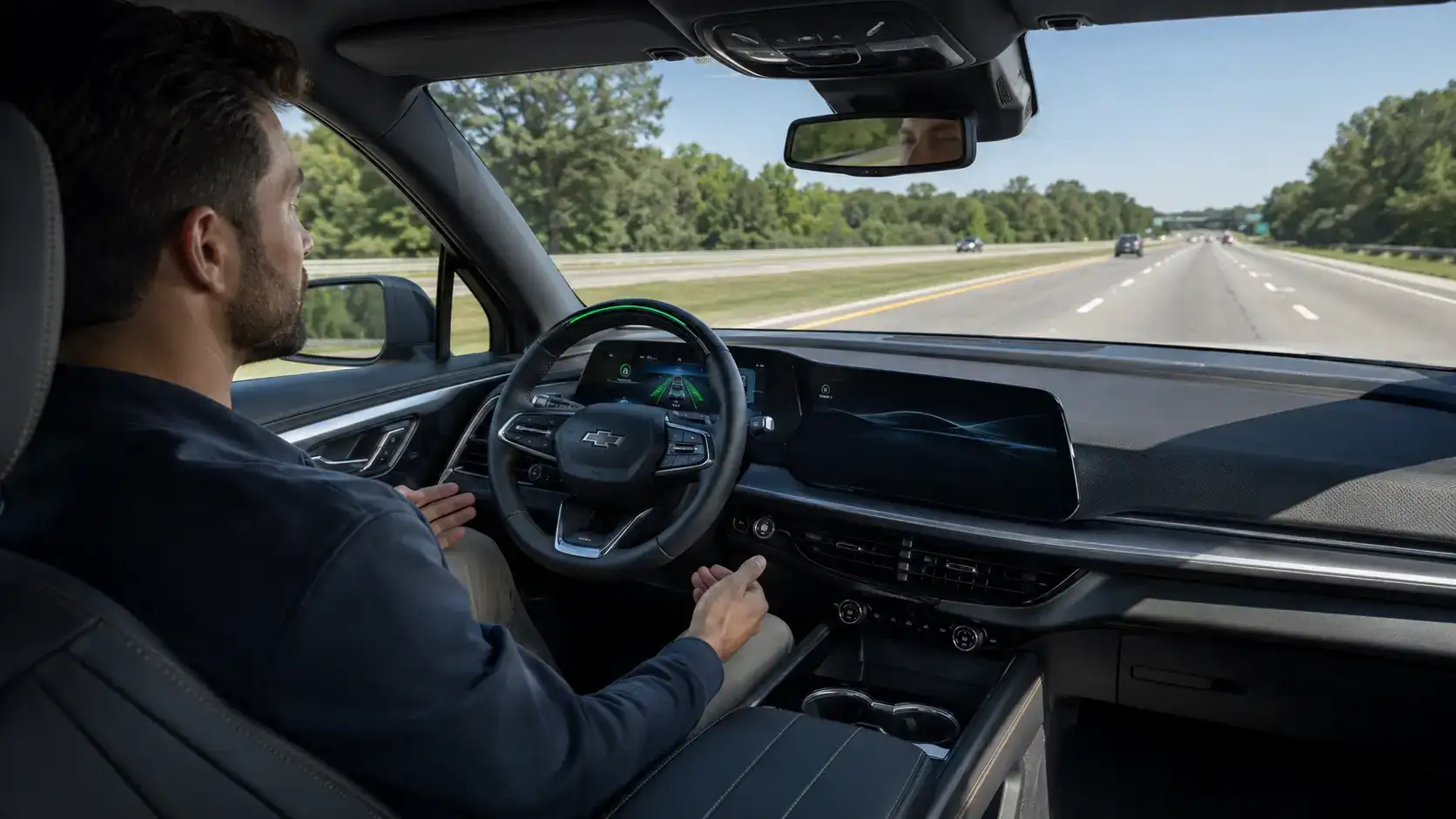
Somewhere past the Kissimmee exit on the way to Tampa, a Silverado driver’s hands come off the wheel. Not because anything went wrong, because a green light bar above the gauge cluster just confirmed it’s safe to let go. The truck holds its lane through a long sweeping curve, eases off the gas as traffic ahead slows, and keeps doing it for the next forty miles of I-4, all while a small infrared camera on the steering column quietly checks that the driver is still watching the road.
That’s Super Cruise: GM’s hands-free highway driving system, available across a wide range of 2026 Chevrolet vehicles, from the Silverado 1500 to the Traverse, Tahoe, Suburban, and several electric models. For Central Florida drivers who regularly cover I-4 between St. Cloud and Orlando, Tampa, or Daytona, or who run Florida’s Turnpike toward Miami, it’s a technology that changes the physical experience of those drives in a way that’s hard to appreciate until you’ve felt it.
This guide explains how Super Cruise actually works, the technology behind it, which roads and vehicles it covers, and where its real limitations are, so buyers at Starling Chevrolet in St. Cloud can decide whether it’s worth adding to their next purchase with a clear picture of what they’re getting.
What Super Cruise Actually Is
Super Cruise combines high-definition LiDAR maps, onboard cameras, radar, GPS positioning, and a driver attention camera to keep a vehicle in its lane and manage its speed relative to surrounding traffic, without requiring hands on the wheel. It launched in 2017 as the first true hands-free driver assistance system offered on a production vehicle in the United States, and that distinction still matters in 2026, because the system was built from day one for hands-free operation. It wasn’t a hands-on system modified to tolerate a few seconds without contact.
That distinction is more than marketing language. Most driver-assist systems monitor steering wheel grip, or ask for a periodic nudge to confirm you’re paying attention. Super Cruise does something fundamentally different: it watches your eyes. As long as the driver-facing infrared camera confirms your gaze is on the road ahead, your hands can stay off the wheel continuously on compatible roads. It isn’t a loophole around hands-on requirements, it’s the system GM built specifically to operate this way.
A Quick History: From the CT6 to 750,000 Miles
When Super Cruise debuted on the 2018 Cadillac CT6, the innovation wasn’t lane centering or adaptive cruise, those already existed elsewhere. The innovation was combining pre-mapped highway data with a driver attention camera to create something genuinely hands-free, not just hands-off-for-a-moment. GM built the underlying infrastructure, the LiDAR mapping program, the attention camera system, the highway database, specifically for this purpose.
In the years since, the system has expanded to dozens of Chevrolet, GMC, Buick, and Cadillac models, grown its compatible road network past 750,000 miles, added the ability to change lanes on command, gained trailer-towing compatibility, and sharpened its attention-monitoring accuracy. The version available to Chevy buyers today is meaningfully more capable than the system that launched in 2018, while keeping the same core idea: genuinely hands-free, on pre-mapped divided highways, with your attention continuously confirmed.
750,000 miles of compatible roads — roughly three times the distance from Earth to the Moon, or 130 coast-to-coast U.S. road trips.
Not Self-Driving, and Why That Distinction Matters
Super Cruise is a Level 2 driver assistance system. That classification isn’t a technicality, it defines what the system will and won’t do. The driver must remain attentive at all times. The attention camera isn’t optional monitoring sitting in the background; it’s the operational foundation of the entire system. Look away too long, and Super Cruise escalates its alerts and eventually hands control back, whether you’re ready or not.
The system doesn’t handle intersections, off-ramps, construction zones, or unmapped roads. It won’t replace your judgment on surface streets, in parking lots, or anywhere outside its defined network of compatible highways. “Hands-free” applies specifically to the pre-mapped, divided-highway environment where the system has the data and sensing confidence to operate without wheel contact, nowhere else.
What it eliminates, on the roads where it works: the physical fatigue of holding a wheel steady for two or three hours straight, the constant micro-corrections that quietly wear a driver down on a long, straight highway, and the low-grade attention tax that manual lane-centering demands even when nothing is happening.
What it doesn’t eliminate: the requirement to stay awake, alert, and ready to take back control. The camera is watching continuously. Glance down at a phone too long, drift toward sleep, or consistently look away from the road, and the system disengages and hands the truck back to you. That’s not a limitation to apologize for, it’s the design choice that makes hands-free driving responsible instead of reckless.
How Super Cruise Works
Four systems run simultaneously to make Super Cruise possible: a LiDAR map database, an onboard sensor suite of cameras, radar, and GPS, the driver attention camera, and the vehicle’s own steering, braking, and throttle systems. Understanding how they work together explains both why Super Cruise performs so confidently on compatible roads, and why it simply can’t operate anywhere else.
The LiDAR map is the foundation everything else builds on. GM has spent years scanning compatible highways with high-definition LiDAR, Light Detection and Ranging, sensors that capture centimeter-accurate three-dimensional road geometry: lane widths, curvature, grade changes, lane markings, infrastructure features, all of it. That map tells the system exactly what the road should look like at every point along the route, giving the vehicle’s real-time sensors a reference to check themselves against. On a road GM hasn’t mapped, none of that reference data exists, and the system simply won’t engage.
The onboard sensors handle the real-time half of the equation. Forward-facing cameras read the actual lane markings in front of the vehicle. A front radar system tracks the speed and position of traffic ahead. GPS pins the vehicle’s location within the LiDAR map down to the centimeter. Fused together, these systems create a continuous, redundant picture of where the vehicle is and what’s around it, the picture the steering, braking, and throttle systems respond to dozens of times per second.
The driver attention camera is the piece that makes all of this safe to use hands-free. Mounted on the steering column, the infrared camera tracks head position, eye gaze direction, and general alertness throughout every Super Cruise engagement. Eyes on the road, and the green light bar on the wheel stays lit, the system runs freely. Eyes drift, and the first response is gentle: a flashing light bar, a light vibration in the seat. Keep not responding, and the alerts escalate until the system disengages and returns control. None of this is negotiable, and that’s exactly what makes the hands-free part trustworthy.
2026 Chevy Models With Super Cruise
Super Cruise has grown well past its original Cadillac-only positioning. For 2026, it spans trucks, full-size SUVs, mid-size SUVs, and a growing slate of electric models, though availability still depends on trim level, not just the model name.
|
Model |
Trims with Super Cruise |
|
Silverado 1500 |
LTZ, High Country |
| Tahoe |
Premier, High Country |
|
Suburban |
LT, RST, Premier, High Country |
| Traverse |
Premier, RS |
|
Silverado EV |
WT 4WD, RST, Trail Boss |
|
Equinox EV |
2RS, 3RS |
| Blazer EV |
RS |
Notice the Suburban’s spread here, it’s available starting at the LT trim ($66,700), which is notably more accessible than the Tahoe’s Premier-and-up requirement. And the Traverse’s availability on Premier and RS puts it within reach of the vehicle that’s actually the most popular family pick in the Chevy lineup.
One capability sets Super Cruise apart from every other hands-free system on the market right now: it works while towing. The Silverado, Traverse, and a handful of other GM truck-platform models support Super Cruise with a trailer attached, using trailer geometry data the driver provides to widen the system’s safety margins and adjust its lane-monitoring parameters. Most competing hands-free systems simply can’t handle a trailer, its width, movement, and sensor reflections confuse the lane-detection logic enough that the systems won’t engage at all. For a Silverado owner running the Turnpike or I-4 with a boat or camper behind them, that’s the difference between hand fatigue on the most demanding leg of the trip, and not.
What Else It Can Do
Beyond the core hands-free lane-centering and speed management, a few features have been added over the years that change how the system behaves day to day.
Lane Change on Demand lets the driver trigger a lane change just by hitting the turn signal while Super Cruise is active. The system checks the target lane with its side cameras and radar, then completes the move on its own, you signal the intent, Super Cruise handles the execution. Automatic Lane Change, available on select vehicles, goes a step further and can initiate the move itself without a turn signal when it detects slower traffic ahead, on roads where that capability is enabled. And Enhanced Navigation, when built-in navigation is active, uses your actual destination to anticipate upcoming mapped exits, giving you advance warning before a transition where Super Cruise is about to hand control back.
What It Costs
Every new 2026 Chevy equipped with Super Cruise comes with a three-year complimentary trial that starts from the first time you use it. During those three years, you get the full system, every compatible road, every feature, every over-the-air network expansion, at no additional cost. After the trial ends, continuing access runs roughly $25 a month, or $250 a year, though GM’s pricing is subject to change and worth confirming at the time of purchase.
That free trial changes the math considerably. Buy a Silverado LTZ today, and you’re not deciding whether Super Cruise is worth paying for, you’re deciding that three years from now, with three years of actual experience behind you. GM’s own survey data says over 80 percent of Super Cruise users find it makes driving meaningfully more relaxing, and owners who have it consistently rank it among the most valued features in the vehicle. For St. Cloud buyers covering serious interstate miles, the trial is close to a no-downside way to find out if it earns a permanent spot in your driving routine.
Where It Works in Florida
Florida happens to be one of the better states in the country for actually using Super Cruise, flat terrain, well-maintained interstates, and consistent lane markings on the major corridors all play to the system’s strengths. The 750,000-mile network covers every major Florida interstate and U.S. highway, and the recent expansion into secondary highway coverage means even some smaller connecting routes between Florida cities are now compatible.
For St. Cloud and Kissimmee drivers, that means the routes you’re actually using are covered. I-4 in both directions handles the run to Orlando (about 20 miles), Tampa (about 80 miles), and Daytona Beach (about 60 miles). The Turnpike runs south toward Miami, roughly 220 miles through Fort Lauderdale, and connects north to the I-75 corridor, which is itself fully compatible from the Gainesville area down through Tampa.
What it doesn’t cover is just as worth knowing. US-192, the main arterial running straight through St. Cloud, is not a divided, limited-access highway, so Super Cruise simply won’t activate there, too many intersections, too much speed variability. The system handles its own transitions gracefully: it engages automatically once you reach a compatible stretch and disengages on its own before an exit or a shift to an incompatible road, giving you a light-bar warning and an audio alert well before you need to take back control manually. First-time users tend to find this part reassuring once they’ve seen it happen, the system isn’t going to surprise you with a sudden handoff.
A Few Quick Answers
Is Super Cruise the same as self-driving?
No. It’s a Level 2 driver assistance system, you’re required to stay attentive at all times, and the system is built around confirming that you are.
Does it work on every highway?
No. Only on the pre-mapped, divided-highway network, currently over 750,000 miles in the U.S. and Canada. Surface streets, intersections, and unmapped roads are outside its scope entirely.
Can I tow with it active?
Yes, on the Silverado, Traverse, and select other GM truck-platform models, a capability most competing hands-free systems don’t offer at all.
What happens after the free trial?
Continuing access costs roughly $25/month or $250/year after the three-year complimentary trial included with every equipped 2026 model.
Will it work on US-192 through St. Cloud?
No, it’s not a divided, limited-access highway. Super Cruise is built for interstate and major highway driving, not arterial roads with intersections.
Experience It Yourself at Starling Chevrolet
The clearest way to understand Super Cruise is still to feel it: the green light bar confirming engagement, the wheel holding steady on its own through a curve, the quiet reassurance of the attention camera doing its job in the background. At Starling Chevrolet in St. Cloud, we can set up a test drive that includes a real stretch of I-4 or the Turnpike where the system fully activates. Most people who haven’t experienced a hands-free system before tell us the test drive is the moment it actually clicks.
For buyers weighing a Silverado, Traverse, Tahoe, Suburban, or any other Super Cruise-equipped Chevy, our team will walk through exactly which trims include it, what the three-year trial covers, and what the subscription looks like afterward, honestly, without oversell, based on how you actually drive. Visit us at 1001 E Highway 192 in St. Cloud.

0 comment(s) so far on Chevy Super Cruise Explained: How Hands-Free Driving Works on Chevy Vehicles