




Hurricane Season in Central Florida: How to Prepare Your Chevy for Storm Season and Evacuation
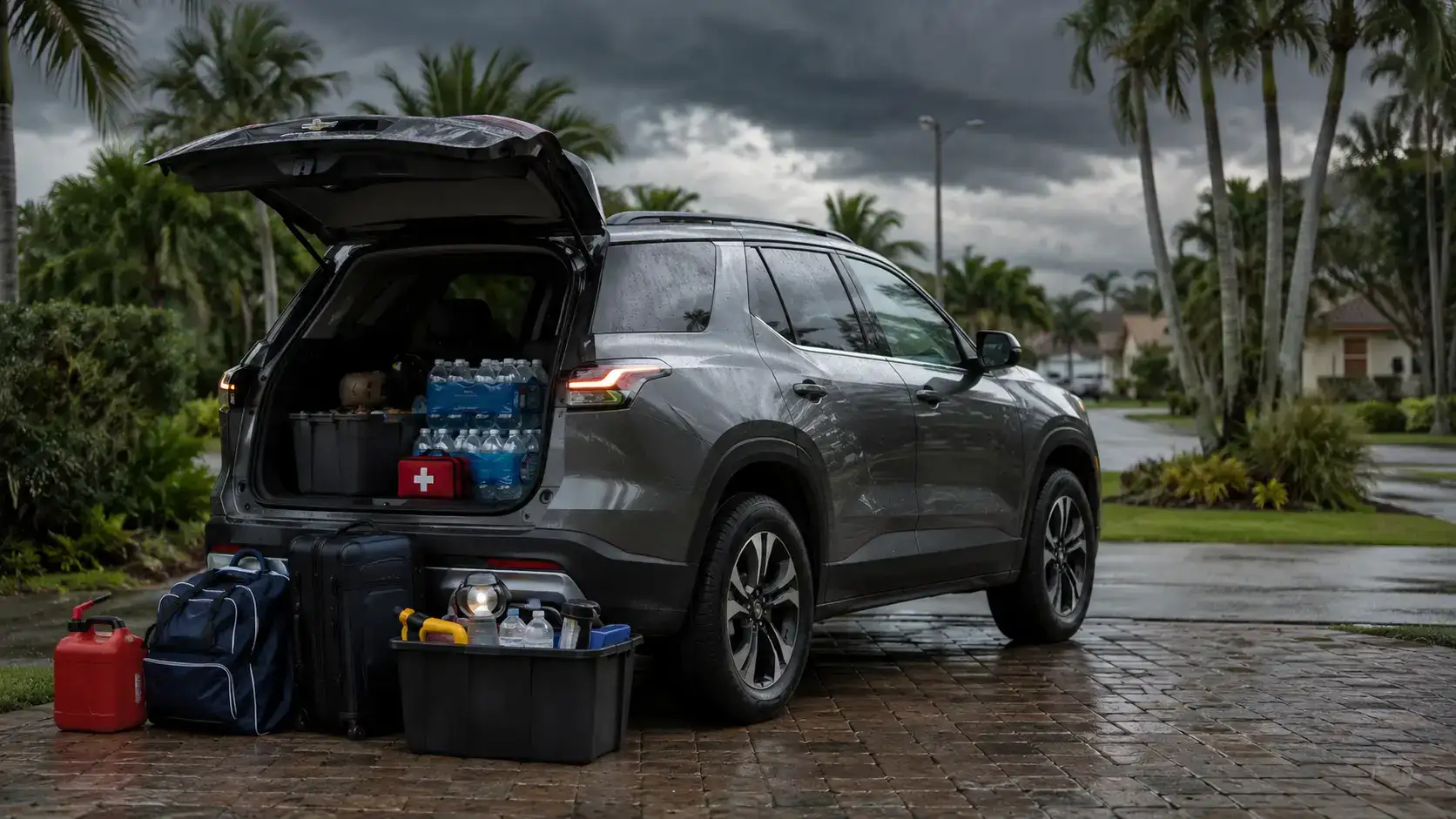
Hurricane season 2026 officially began on June 1st. For residents of St. Cloud, Kissimmee, Davenport, and the broader Osceola County area, the start of the season is not an abstract date on a weather agency calendar, it is the opening of a six-month window that demands practical preparation for a scenario that Central Florida has experienced directly and that the region’s geography makes a recurring reality. Osceola County sits in the path of tropical systems that approach from both the Gulf and Atlantic coasts, and I-4, the primary evacuation artery through the heart of the county, becomes one of the most critical roads in the state when a major storm requires regional movement.
Your vehicle is central to every hurricane preparation scenario. It is how your family evacuates, how supplies are transported, how you return when roads open, and potentially how you power essential equipment during a post-storm outage. At Starling Chevrolet in St. Cloud, we want our customers to be genuinely prepared, not just stocked with supplies, but driving vehicles that are mechanically ready for whatever the season demands. This guide covers the maintenance your Chevy needs before storm season, the emergency kit that should be in the vehicle all season, the Chevy models best suited to each evacuation scenario, and the evacuation routes that St. Cloud and Osceola County drivers need to know before they need them.
Hurricane Season Starts June 1, 2026
The National Oceanic and Atmospheric Administration (NOAA) officially designates June 1 through November 30 as Atlantic hurricane season. The six-month window reflects the atmospheric and oceanic conditions, warm sea surface temperatures, favorable wind shear patterns, and tropical moisture, that support tropical storm and hurricane development in the Atlantic basin. For Florida, and specifically for Central Florida’s I-4 corridor, the peak of the season falls between mid-August and mid-October, when the conditions most favorable to major storm development and Florida landfall alignment converge.
Preparation completed in June, before the season’s peak activity, provides the most valuable lead time. Maintenance performed in October, with a storm three days off the coast, is maintenance under pressure, with limited appointment availability and parts supply constraints. The vehicle preparation described in this guide is most effectively completed in June or July, when service appointments are available on normal timelines and any issues identified can be addressed without urgency.
Why St. Cloud and Osceola County Drivers Need a Plan Now
St. Cloud’s position in Osceola County places it approximately 60 miles from both the Gulf Coast (near Tampa and Sarasota) and the Atlantic Coast (the Space Coast and Melbourne). This geography means that a major hurricane making landfall anywhere across a roughly 120-mile stretch of Florida’s coastlines, from Tampa Bay to Daytona Beach, will produce significant wind, rain, storm surge impacts on coastal areas, and the inland flooding and wind damage that extends well into Central Florida’s interior.
Hurricane Ian in 2022 brought tropical storm force winds and extensive flooding to Osceola County despite making landfall significantly south of the region. The historical record makes clear that Osceola County residents cannot evaluate their hurricane risk based on where a storm makes landfall.
The specific preparation need for St. Cloud and Kissimmee drivers: I-4 is the primary evacuation route, and I-4 is also the primary supply and return corridor for a region of several million people. When a major storm requires evacuation of coastal counties, Brevard, Volusia, Osceola coastal zones, I-4’s capacity is severely stressed. Drivers who have not prepared their vehicles, do not know their evacuation route alternatives, and have not confirmed fuel availability in their vehicle before the storm approaches will encounter the full difficulty of a major evacuation scenario. Preparation completed now means a more controlled experience when the time comes.
Pre-Storm Chevy Maintenance Checklist
Vehicle maintenance is the foundation of hurricane preparedness for drivers. A mechanical failure during an evacuation, on I-4, on the Turnpike, or on US-192 with traffic moving at 15 mph in a pre-storm queue, is both dangerous and, in most cases, preventable. The items below are the highest-priority maintenance checks to complete before the peak of the season, organized by the systems most likely to cause problems if neglected.
The practical recommendation: schedule a comprehensive pre-season service appointment at Starling Chevrolet in June or early July. A single appointment that covers all of the items below takes two to three hours and provides documented confirmation that your vehicle is ready for whatever the season demands.
Battery, Tires, Wipers, and Fluids
- Battery: A weak battery that manages daily starting under normal conditions will often fail under the combined stress of extended idling, air conditioning running continuously, and electrical loads from a fully loaded vehicle. Florida’s heat is particularly hard on batteries, the same thermal cycling that accelerates AC system wear accelerates battery degradation. Have your battery load-tested, not just voltage-checked, a battery that reads 12.4 volts at rest can still fail under load.
- Tires: Check pressure, tread depth, and visible sidewall condition on all four tires. Tires overinflated from sitting in summer heat or underinflated from a gradual leak can create handling issues at highway speed with a heavily loaded vehicle. Tread depth below 4/32 inch in Florida’s heavy rain conditions, which typically accompany any tropical system approach, creates hydroplaning risk that degrades even a cautious driver’s control.
- Wipers: Replace wiper blades annually; Florida’s UV exposure deteriorates rubber faster than in northern climates. Wipers that streak or skip in normal rain will be inadequate in tropical rainfall.
Fluids worth checking before storm season: engine oil and filter (if within 2,000 miles of the next change interval, change it now rather than mid-storm), coolant level and condition, brake fluid level, power steering fluid, transmission fluid condition, and windshield washer fluid, fill it now, you will use it during a tropical weather event. And if your AC hasn’t been cooling as strongly as it should, address it before evacuation season starts: evacuating with a family of four in a vehicle that can’t hold a comfortable cabin temperature in 92-degree heat is both miserable and potentially dangerous for vulnerable family members.
Keep Your Gas Tank Above Half Full All Season
From June 1 through November 30, maintain your vehicle’s fuel level above half at all times. This is not excessive caution, it is the specific practice that distinguishes drivers who execute an orderly evacuation from those who join the lines at the remaining open gas stations when a storm approaches.
When a hurricane watch or warning is issued, gas stations along evacuation routes run out of fuel within 12 to 24 hours.
Drivers who begin the season maintaining a half-tank minimum will have at least 200 to 300 miles of range available at any moment, enough to complete evacuation to a safe destination without depending on finding open stations in a storm-preparation scenario. Here’s what that looks like across the common Chevy lineup:
|
Vehicle |
Tank Size | Combined MPG | Half-Tank Range |
| Silverado 1500 (5.3L V8) | ~26 gal | 17 MPG |
~221 miles |
|
Tahoe / Suburban |
~28 gal | 17 MPG |
~238 miles |
|
Traverse |
~19.4 gal | 22 MPG |
~213 miles |
All of these ranges cover the distance from St. Cloud to Atlanta, Georgia (approximately 460 miles), a common evacuation destination for Osceola County residents, in a single fill on a full tank. The half-tank minimum simply ensures that fill is available when the tank is full, under normal conditions, without competing with a pre-storm rush.
Vehicle Emergency Kit for Florida Drivers
A vehicle emergency kit for hurricane season is different from a roadside kit for normal breakdowns. It needs to sustain a family of four through a 24-hour evacuation delay, power essential devices during a multi-day post-storm power outage, provide basic medical care for minor injuries, and allow access to critical documentation when normal systems may be unavailable. The kit described below is the minimum appropriate for a Central Florida family and fits in the cargo area of most Chevy vehicles without compromising passenger space.
The kit should be assembled now, stored in the vehicle throughout the season, and replenished after any use. The moment to realize your emergency kit is incomplete is not when an evacuation order is issued.
Water, First Aid, Flashlight, Power Bank, and Cash
- Water: One gallon per person per day for at least three days, 12 gallons for a family of four. Store in sealed jugs in the cargo area. Water is the most critical supply because it’s the heaviest and most commonly assumed available, but in the 24 to 48 hours before and after a storm, available is not guaranteed.
- First Aid: A comprehensive kit including bandages, antiseptic wipes, pain relievers (adult and children’s formulas), any prescription medications for family members (minimum one week’s supply), and any allergy medications. Florida evacuation scenarios produce more minor injuries, cuts, blisters, burns, than most residents anticipate.
- Flashlight: LED flashlights with fresh batteries for every household member capable of using one, plus a vehicle-mounted or dashboard-mounted unit. Post-storm assessment of a vehicle, a shelter, or an evacuation route at night requires hands-free lighting.
- Power Bank: A high-capacity portable battery (minimum 20,000 mAh) capable of charging phones multiple times per charge cycle. Communication is your most critical post-storm resource, and phone batteries die faster under stress.
- Cash: At least $300 in mixed denominations. Post-storm ATMs are not functional, electronic payment systems may be unavailable, and vendors operating during recovery frequently accept cash only. The inability to access cash during a storm recovery scenario is a consistent complaint from Florida residents who have been through previous storms.
Documents to Keep in a Waterproof Pouch
A waterproof document pouch in the vehicle should contain copies of all family members’ identification (driver’s licenses, passports, birth certificates), insurance cards for all active policies including vehicle, home, and health, vehicle registration and title documents, prescription information for all family members’ medications, emergency contact information for extended family and out-of-state contacts, and copies of financial account information for access in the event that wallet contents are lost or inaccessible.
These documents should live in a waterproof zipper pouch, not a standard folder, because tropical storm conditions will saturate paper materials in minutes. Photocopies stored in a cloud service accessible from any phone or tablet provide a backup if the physical copies are lost or damaged.
Best Chevy Models for Hurricane Readiness
Different Chevrolet vehicles serve different aspects of hurricane preparedness based on their specific capabilities. Understanding which vehicle in your household is best suited to each scenario, evacuation, supply transport, towing, daily driver fuel efficiency, allows families who own multiple vehicles to deploy each one appropriately.
The general principle: match vehicle capability to the specific demand of each scenario. The most capable vehicle in the household is not always the right choice for every hurricane-related task, and fuel efficiency matters more during an extended post-storm period when fuel availability is constrained.
Suburban and Tahoe: Family Evacuation and Cargo
The Chevrolet Suburban and Tahoe are the best-positioned Chevy models for family evacuation scenarios where multiple people, significant luggage, and emergency supplies need to move together in a single vehicle. The Suburban’s 144.5 cubic feet of maximum cargo volume is the most relevant specification for a storm evacuation: it can carry clothing, food, water, and supplies for a family of four for five to seven days in the cargo area while maintaining full passenger capacity in all three rows. The Tahoe’s 122.8 cubic feet of maximum cargo provides the same fundamental capability at a slightly more compressed scale. Both vehicles’ 8,300 lb towing capacity means they can simultaneously evacuate a family and a trailer, boat, or camper if needed.
AWD is the relevant drivetrain for evacuating during or after storm conditions. Flooded roads, wet surfaces, debris-covered pavement, and unpaved detour routes all favor the AWD advantage over RWD. If your Suburban or Tahoe is currently in RWD configuration, the pre-storm service appointment is the appropriate time to confirm that AWD engagement is functioning correctly for the models where it’s available as an option.
Silverado 1500: Towing Trailers, Boats, and Supplies
The Silverado 1500 is the most capable hurricane evacuation vehicle for scenarios that involve towing: a boat that needs to be moved before storm surge, a utility trailer loaded with supplies, a camper for shelter at a designated evacuation site, or a car trailer evacuating a secondary vehicle. With maximum towing capacity ranging from 9,400 lbs (2.7L TurboMax) to 13,300 lbs (Duramax diesel or 6.2L V8 with Max Trailering Package), the Silverado 1500 handles every recreational and utility trailer common in the Osceola County area.
The Duramax diesel Silverado has specific storm season advantages: its approximately 25 MPG combined fuel economy extends the range per tank significantly compared to the V8 options, and diesel fuel is often more available than regular gasoline during post-storm recovery periods, since commercial vehicles, which also run diesel, create demand that the supply chain prioritizes. A diesel Silverado with a full 24-gallon tank can travel approximately 600 miles on a single fill, enough to reach safe destinations in the Carolinas, Georgia, or Alabama from St. Cloud without a refuel stop on most evacuation scenarios. The Silverado’s bed also provides covered storage when properly equipped with a tonneau cover, keeping supplies dry during travel in pre-storm rain.
Traverse and Equinox: Daily Driver Fuel Efficiency
The Traverse and Equinox serve a different hurricane-season role than the Silverado or Suburban: they’re the fuel-efficient daily drivers whose efficiency is most valuable during the extended post-storm period when fuel availability is constrained and conservation matters. The Equinox’s approximately 28 MPG combined and the Traverse’s approximately 22 MPG combined allow more miles per gallon of scarce fuel than any truck or full-size SUV in the lineup. For families who evacuate in a Suburban or Silverado but maintain an Equinox as a second vehicle for post-storm return and daily use during recovery, the Equinox’s efficiency profile is its most relevant hurricane-season attribute.
The Traverse’s three-row seating also makes it a capable evacuation vehicle for families who don’t own a full-size SUV, it seats seven or eight, provides meaningful cargo space with the third row in use, and handles the towing of small trailers and personal watercraft with its 5,000 lb maximum towing capacity. For families whose evacuation scenario doesn’t require the Suburban’s full cargo volume or the Silverado’s towing capability, the Traverse provides most of what matters at a lower fuel cost during the drive to safety.
Evacuation Routes From St. Cloud: I-4, Florida’s Turnpike, and US-192
St. Cloud’s location in north-central Osceola County provides access to multiple evacuation route options that travel in different directions, a meaningful advantage compared to coastal counties with limited evacuation geography. Knowing these routes in advance, and knowing which one to take based on storm approach direction, is the planning that separates orderly family evacuations from improvised ones.
The most important pre-season preparation action beyond vehicle maintenance: identify your designated evacuation shelter and your family’s out-of-region destination before a storm is named and approaching. Osceola County Emergency Management publishes evacuation zone maps and designated shelter locations at osceolafl.gov, review them now, determine which zone your residence falls in, and establish a destination and route plan that every adult family member knows.
|
Route |
Direction / Destination | Distance |
Use When |
|
I-4 West |
Tampa Bay | ~80 miles | Gulf-approach storms |
| I-4 East | Daytona / I-95 | ~60 miles |
Atlantic-approach storms |
|
FL Turnpike North |
Orlando → I-75 → Georgia | Varies | Broad threat, both coasts |
| US-192 | Melbourne (east) / Kissimmee (west) | Local |
Local prep, Turnpike access |
When Gulf Coast evacuation zones are activated, I-4 westbound will be heavily congested. When Atlantic coast or Space Coast zones are activated, I-4 eastbound toward Daytona and I-95 carries the traffic load. Florida’s Turnpike, accessible from US-192 in Kissimmee or from SR-91 in the St. Cloud area, provides the most direct northbound route toward Orlando, Gainesville, and ultimately I-75 north toward Georgia, the preferred direction when both coasts are under threat from a broad storm system.
Contraflow operations, reversing lanes to add outbound capacity, are regularly implemented on I-4 and the Turnpike during major evacuations. Monitor Osceola County Emergency Management and FDOT’s FL511 for current contraflow status when evacuating.
Get Your Chevy Hurricane-Ready at Starling Chevrolet St. Cloud
Starling Chevrolet’s service department is ready to help St. Cloud, Kissimmee, and Osceola County families prepare their Chevy vehicles for storm season. A pre-season service appointment in June or July covers battery load testing, tire inspection and rotation, fluid checks and top-offs, AC performance verification, wiper replacement, and any deferred maintenance that could create a problem under storm-season driving demands. For families with trailers, boats, or campers, our service team can also inspect trailer hitch connections, verify trailer brake controller function, and check towing package hardware integrity.
We’re at 1001 E Highway 192 in St. Cloud, directly on one of the primary evacuation preparedness corridors. Schedule your pre-season service appointment now, before the peak of the season creates the appointment backlog that always follows a storm approaching the region. The best time to be ready is before you need to be.
Conclusion
Hurricane season 2026 is here, and preparation completed in June is worth significantly more than preparation attempted under the pressure of an approaching storm. The core vehicle preparation: service your Chevy’s battery, tires, wipers, fluids, and AC system before the season’s peak; keep the fuel tank above half at all times from June 1 through November 30; build and maintain an emergency kit with water, first aid, communication power, cash, and waterproof documents; and know your evacuation routes, I-4, the Turnpike, and US-192, before you need to use them. Match your vehicle’s capability to your household’s evacuation scenario: the Suburban and Tahoe for family evacuation with maximum cargo, the Silverado for towing scenarios, and the Traverse and Equinox for fuel-efficient daily driving and recovery-period use.

0 comment(s) so far on Hurricane Season in Central Florida: How to Prepare Your Chevy for Storm Season and Evacuation