




Florida Summer Vehicle Care: Chevy Maintenance Guide for St. Cloud Owners
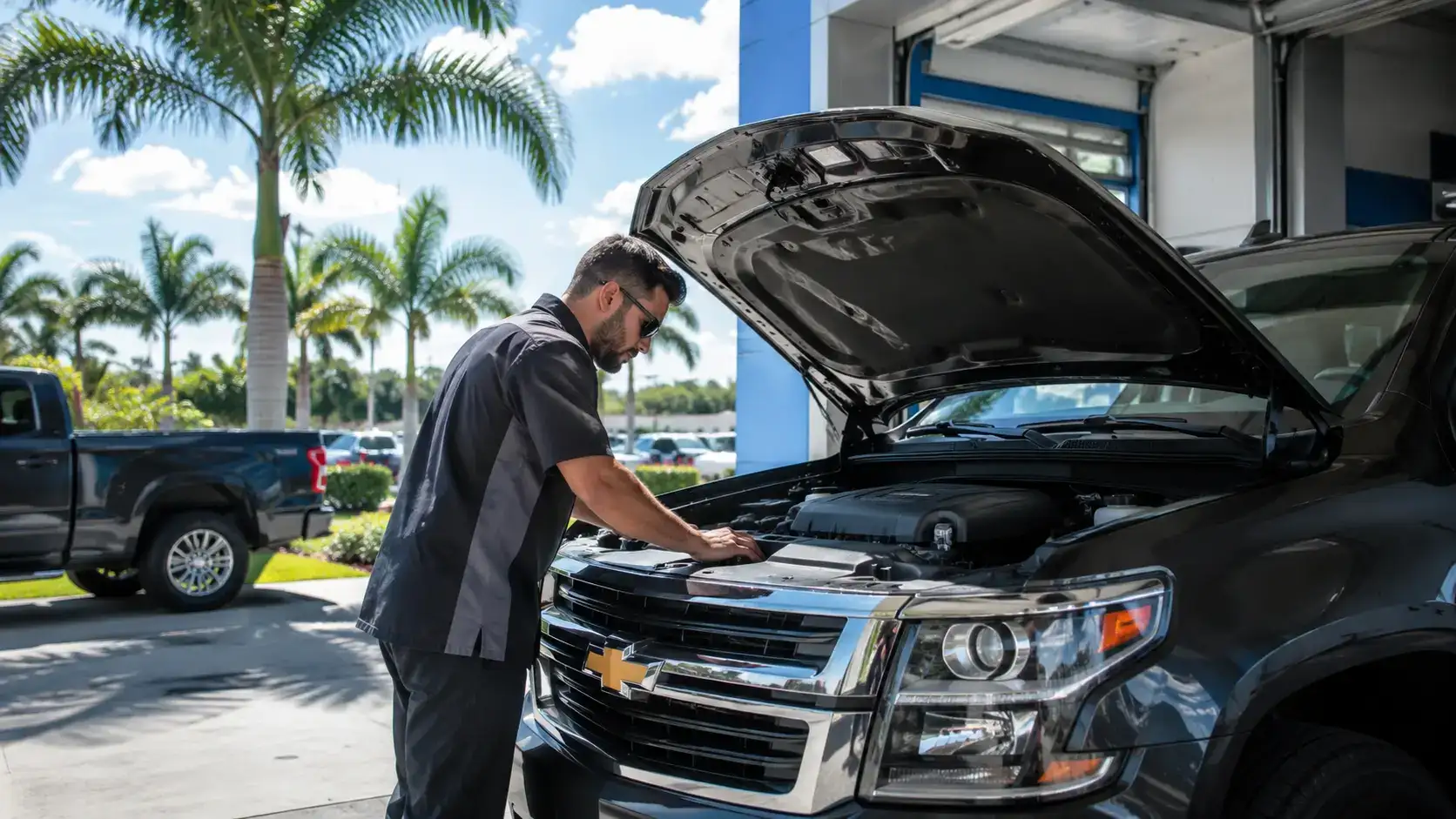
Summer in Central Florida is not a season, it is a survival test for vehicles. From June through September, the combination of daily high temperatures in the 90s, relative humidity above 80 percent, intense UV radiation that makes Florida one of the highest-UV states in the country, and the afternoon thunderstorm cycle that dumps two inches of rain on roads that were bone-dry an hour earlier creates operating conditions that neither your vehicle’s manufacturer nor national maintenance schedules account for fully. St. Cloud and Osceola County sit in the heart of this environment, and the vehicles that arrive at our service bay at Starling Chevrolet with expensive summer repairs almost always have one thing in common: the specific Florida maintenance steps that would have prevented the problem were deferred.
This guide covers the five maintenance priorities that Central Florida summer specifically amplifies for Chevy owners: air conditioning, battery, cooling system, tires, and interior protection. Each section tells you what to check, what Florida’s conditions specifically do to that system, and when to handle it yourself versus bringing it to our service department. The time investment is measured in minutes and a modest service cost. The alternative is measured in expensive unplanned repairs in August heat.
Why Florida Heat Is Tough on Your Chevy
The engineering specifications and maintenance intervals for your Chevrolet were designed around national average conditions, conditions that describe a vehicle operated in a temperate climate with seasonal variation, moderate humidity, and UV exposure that is meaningful but not extreme. Central Florida’s summer violates every one of those assumptions simultaneously.
Ambient temperatures of 90 to 95 degrees Fahrenheit in St. Cloud from June through September give every vehicle system 30 to 35 fewer degrees of thermal headroom than national-average maintenance intervals assume. When a vehicle is parked in direct sun, as most Central Florida vehicles are, for most of the day, cabin temperatures reach 140 to 160 degrees Fahrenheit, and the dashboard surface can exceed 180 degrees. Engine oil, transmission fluid, coolant, and battery electrolyte all degrade faster at these temperatures. UV radiation at Florida’s subtropical latitude breaks down rubber, plastic, and paint surfaces at rates that northern-climate owners do not experience. Humidity that exceeds 80 percent creates the moisture environment that accelerates corrosion on electrical connections, brake components, and underbody metal. And the afternoon thunderstorm cycle creates wet-road traction demands on tires whose pressures have been elevated by a full day of heat exposure.
The maintenance responses to these conditions are specific: more frequent oil changes, more aggressive coolant service intervals, more frequent battery testing, monthly tire pressure checks, and proactive AC and interior protection steps that the national maintenance schedule treats as optional. For St. Cloud Chevy owners, these are not optional extras, they are the specific investments that separate vehicles that run reliably through the summer from the ones that do not.
AC System Service: The Most-Used Feature of a Florida Summer
Your Chevrolet’s air conditioning system runs more hours annually in St. Cloud than in any comparable vehicle operated in a northern market. It runs in June, July, August, and September at near-maximum capacity. It runs in October, November, and March at regular capacity. It runs in December and January at moderate demand. A vehicle that would log 1,500 compressor hours annually in Atlanta logs 3,000 to 4,000 hours in Central Florida. That compressor hour accumulation accelerates wear on every AC system component, seals, refrigerant charge integrity, condenser performance, and blower motor life, in ways that the national 100,000-mile service interval does not capture.
The early warning signs that your Chevy AC system is working toward a failure are identifiable weeks or months before the failure itself. The most common early indicator: the system produces cool air but not the cold air it used to deliver, a symptom that almost always indicates a refrigerant charge that has slowly leaked through aging seal micro-leaks. Refrigerant loss is gradual and the temperature change is gradual enough that drivers often adapt without registering it as a problem until a passenger comments or until a particularly brutal July afternoon makes the inadequacy undeniable. A refrigerant recharge and seal inspection typically costs $100 to $200 at our service department. A compressor failure that results from running a system on low refrigerant costs $700 to $1,200. The musty or mildew smell from the vents, common in Florida’s humid environment, indicates bacterial growth on the evaporator core and is addressed with an evaporator cleaning treatment plus cabin air filter replacement, typically $150 to $250. Addressing these symptoms when they appear is the investment that prevents the more expensive repair they lead to.
The one AC maintenance item that every St. Cloud Chevy owner should handle annually and that most defer too long: the cabin air filter. It screens the air entering the HVAC system from the fresh air intake, and in Osceola County’s subtropical environment, high pollen load, humid air, and the coastal particulate from the surrounding waterways, it clogs faster than in any dry-climate market. A severely clogged cabin air filter restricts airflow through the evaporator, reduces the air volume the system can cool, and makes the AC appear to be underperforming when the mechanical components are functioning correctly. The cabin air filter on most Chevy vehicles is accessible behind the glove box without tools, costs $15 to $40 in parts, and takes 5 to 10 minutes to replace. It should be on an annual or 12,000-mile interval in Central Florida.
Battery and Cooling System Checks
Florida’s heat kills car batteries faster than cold weather does, a fact that surprises many vehicle owners who associate battery failure with winter cold starts. The mechanism is different but the result is the same: batteries fail. In cold climates, batteries die because cold slows the chemical reaction that produces current. In Florida, the sustained heat accelerates internal chemical degradation, electrolyte evaporation, plate sulfation, and separator breakdown, that reduces capacity from the inside. The battery that starts the vehicle normally every morning in April becomes the battery that will not start a hot engine in the Target parking lot in August.
Florida Heat Cuts Battery Life by Up to 35%
Battery lifespan in Florida’s heat is approximately 35 percent shorter than in temperate climates, a figure that the battery industry and independent testing sources consistently document. A battery that would last five to six years in Tennessee lasts three to four years in Central Florida. For Chevy owners whose battery is approaching its third anniversary in Osceola County service, scheduling a battery load test, not just a voltage check, but a load test that evaluates the battery under the current demand of starting a hot engine, is the appropriate action. A load test takes approximately 10 minutes and is included in our multi-point inspection service. A battery that fails a load test is replaced before it strands the vehicle; a battery that passes a load test provides confidence for the season ahead.
The specific vulnerability pattern for Central Florida batteries: the battery manages normal daily starts through the spring. As summer heat builds through June, the battery’s reduced capacity from heat degradation becomes more significant. By July and August, the combination of a degraded battery, a hot engine requiring more cranking energy, and an AC compressor adding electrical load at startup creates the conditions where a borderline battery fails at the worst possible time. Pre-season testing in May or early June identifies the batteries that will not make it through August before August arrives.
Coolant Flush Intervals for Chevy Trucks and SUVs
Chevrolet’s recommended coolant flush interval for current vehicles with Dex-Cool extended-life coolant is 5 years or 150,000 miles, a specification designed for average operating conditions. In Central Florida’s sustained heat, the appropriate practical interval is 5 years without exception and closer to 4 years for vehicles that regularly operate under high thermal load, towing, heavy payload, extended idling in traffic. Coolant chemistry breaks down faster at sustained high temperatures; degraded coolant has reduced heat-transfer efficiency, reduced corrosion inhibitor effectiveness on the aluminum engine components and cooling system, and reduced pH stability that allows acid formation that attacks seals and gaskets.
The two cooling system components most frequently overlooked in Central Florida maintenance: hoses and the radiator cap. Hoses that are pliable and smooth at normal temperature but soft or mushy when hot are approaching failure, the high-temperature operation that Florida’s ambient conditions impose is exactly what reveals hose degradation before it becomes a roadside failure. The radiator cap maintains the cooling system at its designed operating pressure; a cap that no longer seals at its rated pressure allows the coolant to boil at a lower temperature, reducing the system’s thermal margin in the conditions where margin matters most. Hose inspection and radiator cap testing are included in our summer service check at Starling Chevrolet St. Cloud.
Tires and Summer Driving Safety
Tires are the most safety-critical component on any vehicle, and Florida’s summer creates a specific combination of conditions that affects tire performance and safety in ways that are not obvious without understanding the underlying physics. Heat, highway driving, wet afternoon roads, and the tire pressure changes that temperature swings create combine to make summer tire management in Central Florida a more active process than the ‘check tire pressure occasionally’ approach that suffices in more forgiving climates.
The broad tire safety principle for Florida: tires that are adequate for dry, 75-degree springtime driving may be inadequate for the same roads in wet, 93-degree August conditions. Tread depth that stops water under moderate precipitation fails to manage water under the intense rainfall rates of a Central Florida afternoon thunderstorm. Tire pressure that was correct in the morning may be 4 to 5 PSI higher than correct by afternoon. Both conditions create safety margins that are narrower than they appear.
How Heat Changes Your Tire Pressure
Tire pressure increases approximately 1 PSI for every 10 degrees Fahrenheit of temperature increase. In practical St. Cloud terms: a tire inflated to 35 PSI in a garage at 75 degrees in the morning will read approximately 37 to 38 PSI after sitting in direct afternoon sun in a parking lot at 95 degrees. More importantly, the same tire on a vehicle parked overnight and checked cold the following morning, when temperatures may have dropped to 78 degrees, will read approximately 35 to 36 PSI: within spec, with no action required. But the tire that was overinflated by summer heat all day has been generating internal heat buildup from the stiffer sidewall contact that overinflation creates, accelerating wear on the center tread and reducing the tire’s water evacuation efficiency on wet roads.
The Florida-specific tire pressure check protocol: always check pressure cold, before the first drive of the day or after the vehicle has sat for at least 3 hours. Check against the specification on the door jamb sticker, not the maximum pressure listed on the tire sidewall (which is the tire’s maximum safe pressure, not the vehicle’s recommended operating pressure). Adjust quarterly at minimum, or monthly during the summer peak. The Silverado, Equinox, Traverse, and Tahoe all have tire pressure monitoring systems (TPMS) that alert when pressure drops 25 percent below specification, but this alert fires after the pressure problem already exists, not before. Manual monthly checks catch gradual pressure drift before TPMS alerts.
Protecting Your Chevy Interior From the Sun
The Central Florida sun does to vehicle interiors what it does to everything else exposed to subtropical UV radiation at this latitude: it fades, cracks, and degrades materials at a rate that buyers who have not owned a vehicle here sometimes find surprising. A dashboard that looks factory-fresh after two years in Michigan looks weathered after two years of direct Florida sun exposure on an unprotected vehicle. The cumulative UV exposure in St. Cloud is among the highest in the continental United States, and interior protection is not vanity maintenance, it is preservation of resale value.
The most effective and most accessible interior protection is the windshield sunshade. A reflective sunshade that covers the full windshield area reduces peak dashboard temperature by 30 to 40 degrees Fahrenheit, enough to meaningfully slow the UV degradation of dashboard plastics, steering wheel materials, and seat surfaces. A dashboard that reaches 165 degrees without a sunshade reaches 125 to 135 degrees with one. The difference in long-term material preservation is significant. Sunshades are inexpensive ($15 to $30 at any auto parts store), take 30 seconds to deploy, and are one of the highest-return interior maintenance investments available. Window tinting, either factory tinted glass or aftermarket applied tint within Florida’s legal limits, provides continuous UV reduction regardless of whether a sunshade is deployed.
For leather and leatherette seating surfaces, common on Silverado LTZ, Suburban Premier, and other higher-trim Chevrolet vehicles, UV protectant applied to the seat surfaces every 3 to 6 months prevents the cracking and fading that direct sun exposure causes. Products designed for automotive leather and vinyl surfaces are available at any auto parts store; the application takes approximately 15 minutes for a full interior treatment. Conditioned leather is visibly more supple and crack-resistant than unprotected leather; the maintenance difference is apparent on 5-year-old vehicles that received consistent treatment versus those that did not.
The cooling implication that most drivers do not account for: the UV damage that affects dashboard and seat surfaces is not just aesthetic. A dashboard that has been degraded by sustained UV exposure is more brittle and more prone to cracking than a protected one, and cracked dashboard components are an interior repair that costs $200 to $800 depending on the specific vehicle and component. The $30 investment in a quality sunshade and the $15 investment in UV protectant prevents the $500 dashboard repair with a favorable trade-off that compounds over the ownership period.
Schedule Summer Service at Starling Chevrolet St. Cloud
Starling Chevrolet ‘s service department at 1001 E Highway 192 in St. Cloud handles the summer maintenance items described in this guide as part of a comprehensive summer vehicle service appointment. A single appointment covers: AC performance check and cabin filter replacement; battery load test; cooling system inspection including hose condition, coolant level and quality, and radiator cap test; tire pressure adjustment and tread depth measurement; multi-point inspection that covers additional components our technicians identify during the appointment; and any outstanding software updates or technical service bulletin applications relevant to your specific vehicle’s VIN.
Our summer service schedule fills faster in June and July as the season peaks and the appointment backlog builds. Scheduling in late May or early June, before the peak heat and the peak appointment demand converge, is the preparation habit that ensures your Chevy is ready before the most demanding months of the year arrive. Vehicles that come through our service in May leave with documented assurance that every summer-critical system has been checked; vehicles that defer to August leave with less time before the season peaks and, in some cases, with repairs that would have been simpler at an earlier stage.
Conclusion
Central Florida’s summer is the most demanding operating environment for vehicles in the continental United States, and St. Cloud’s position at the heart of that environment makes summer maintenance not an optional best practice but a necessary discipline for Chevy owners who want their vehicles to perform reliably through the season. The five priorities, AC system service including cabin filter replacement, battery load testing with Florida’s 35 percent accelerated degradation in mind, cooling system checks including hoses and radiator cap, monthly cold tire pressure verification accounting for temperature swings, and interior UV protection with sunshades and UV protectant, address the specific failure modes that Florida’s summer accelerates rather than the generic maintenance calendar that assumes a more forgiving climate.
Schedule your summer service appointment at Starling Chevrolet , 1001 E Highway 192 in St. Cloud. Our certified service team is ready to get your Chevy through its toughest season.

0 comment(s) so far on Florida Summer Vehicle Care: Chevy Maintenance Guide for St. Cloud Owners